
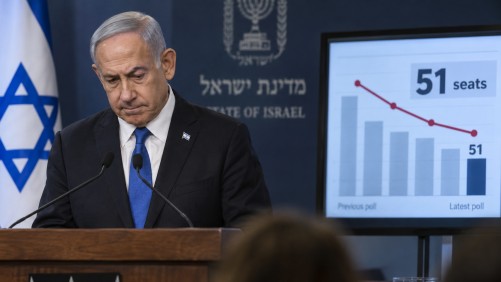
Israel’s political landscape remains uncertain as recent polling suggests a stalemate in the upcoming parliamentary elections. The poll, conducted ahead of the October 27 election, indicates that neither Prime Minister Benjamin Netanyahu’s political bloc nor the main Zionist opposition bloc is poised to secure the necessary 61 seats for a majority in the 120-member Knesset.
The survey, which included 500 respondents and has a margin of error of 4.4 percentage points, projects Netanyahu’s bloc to win 51 seats. Within this group, Likud is anticipated to take 22 seats, while religious parties such as Shas and United Torah Judaism may secure 10 and 9 seats, respectively. On the other side, the Zionist opposition is predicted to garner 55 seats, leaving both blocs short of a majority.
The Yashar party, led by former IDF chief Gadi Eisenkot, is expected to become the largest single party with 24 seats. Meanwhile, Naftali Bennett’s B’Yachad might capture 14 seats, with Yisrael Beytenu and the Democrats projected to win nine and eight seats, respectively. Additionally, two Arab-majority parties could collectively secure 14 seats, potentially positioning them as key players in coalition negotiations.
As the possibility of a deadlock looms, opinions on the next steps are divided. Approximately 31.4% of those surveyed favored conducting another election if the stalemate persists, whereas 29.6% preferred a unity government. Among Netanyahu’s supporters, 45.02% leaned towards forming a unity government, while 39.79% of those opposing him advocated for a minority government solution.
Beyond the leading parties, several smaller groups, including Ofer Winter’s People of Israel party, HaMiluimnikim, and Blue and White, failed to meet the electoral threshold of 3.25% needed to enter the Knesset. As campaigning continues, the evolving political dynamics suggest a complex path ahead for Israel’s coalition-building efforts.