
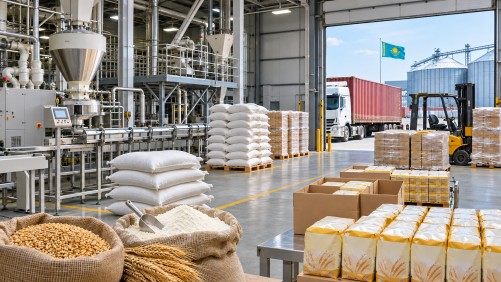
Kazakhstan’s processed agricultural exports have surged by 35% to reach $3.4 billion, a development that underscores the growing global demand for the country’s value-added food and agricultural products. This increase in processed goods has raised their share in Kazakhstan’s total agricultural exports from 51.3% to 53.3%, reflecting a strategic shift towards enhancing domestic agricultural processing capacity.
Aidarbek Saparov, Kazakhstan’s Agriculture Minister, has highlighted the government’s priority of expanding the production and export of finished agricultural products. He emphasized that processing raw materials domestically, as opposed to exporting unprocessed grain, can yield higher economic returns. This strategic focus is particularly significant given Kazakhstan’s annual production of approximately 18–20 million tonnes of wheat and 1–1.2 million tonnes of corn. Notably, this year’s corn harvest reached 1.7 million tonnes, opening new avenues for the country’s food-processing industry.
The current processing infrastructure in Kazakhstan handles over 5 million tonnes of grain annually, with advanced deep-processing technologies accounting for around 510,000 tonnes. In a related development, the production of starch products reached 145,100 tonnes in 2025, marking a 21.8% increase from the previous year. Bioethanol production has also seen significant growth, more than doubling to 21,000 tonnes year on year.
Looking ahead, the Agriculture Ministry plans to establish six major wheat and corn processing facilities by 2029. These projects are expected to process a combined total of 5.8 million tonnes of raw agricultural materials each year. This expansion is anticipated to bolster Kazakhstan’s agricultural processing industry, enhance exports of finished products, and maximize the economic value derived from domestic agricultural resources.